













Introduction
Power transformers are among the most critical and expensive assets in electric power systems. Ensuring their long term reliability requires a deep understanding of transformer condition assessment—particularly the condition of insulation, both solid (cellulose based) and liquid (mineral oil). Traditional line frequency power factor (PF) and dissipation factor (tan δ) tests at 50 or 60 Hz have historically supported maintenance decisions. However, even when test results fall within acceptance limits, they may not truly represent sound insulation health.
Temperature, material type, and test frequency all influence PF measurements, and results obtained at temperatures different from the reference add further complexity. As power grids age, expand rapidly, and face supply constraints for power and distribution transformers, utilities increasingly encounter challenges finding the time and resources to properly interpret test data. Also, asset upgrades, and the introduction of higher voltage levels and new dielectric materials bring more doubts about data interpretation and historical trending. These pressures, along with rising reliability expectations, have accelerated the adoption of frequency based dielectric diagnostics.
This article introduces the principles, applications, and advantages of Dielectric Response in Frequency Domain (DFR) and advanced PF/DF techniques, including their use on power transformers and high voltage (HV) bushings. Case studies are included to highlight practical benefits.
Understanding Transformer Insulation and Life Expectancy
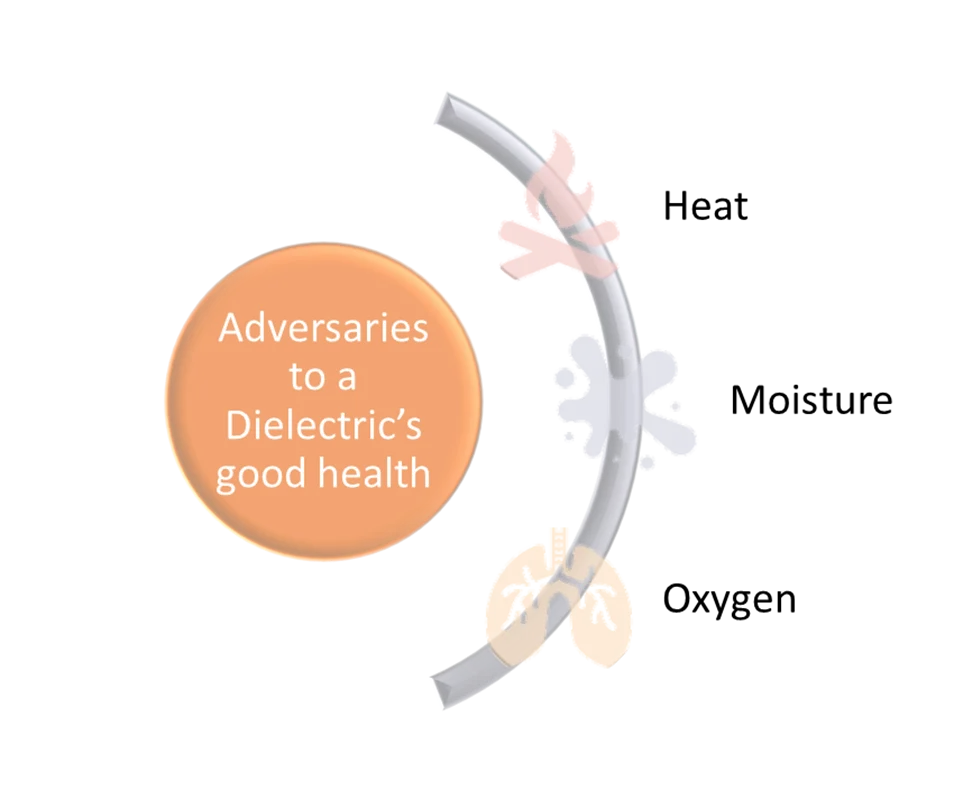
Transformer insulation is continually exposed to electromagnetic and thermal stress. While proper design considers long service life, reliable operation and maintenance are essential. The primary adversaries of transformer and bushing insulation are heat, moisture, and oxygen, each contributing to accelerated deterioration.
As the dielectric system ages, the risk of mechanical, thermal, and electrical failure increases. Industry organizations such as CIGRÉ and IEEE classify failures into three dominant categories:
- Thermal failure
- Dielectric failure
- Mechanical failure
Accurate diagnostics must therefore evaluate both the solid and liquid insulation, detect changes in dielectric characteristics, and support predictive maintenance strategies.
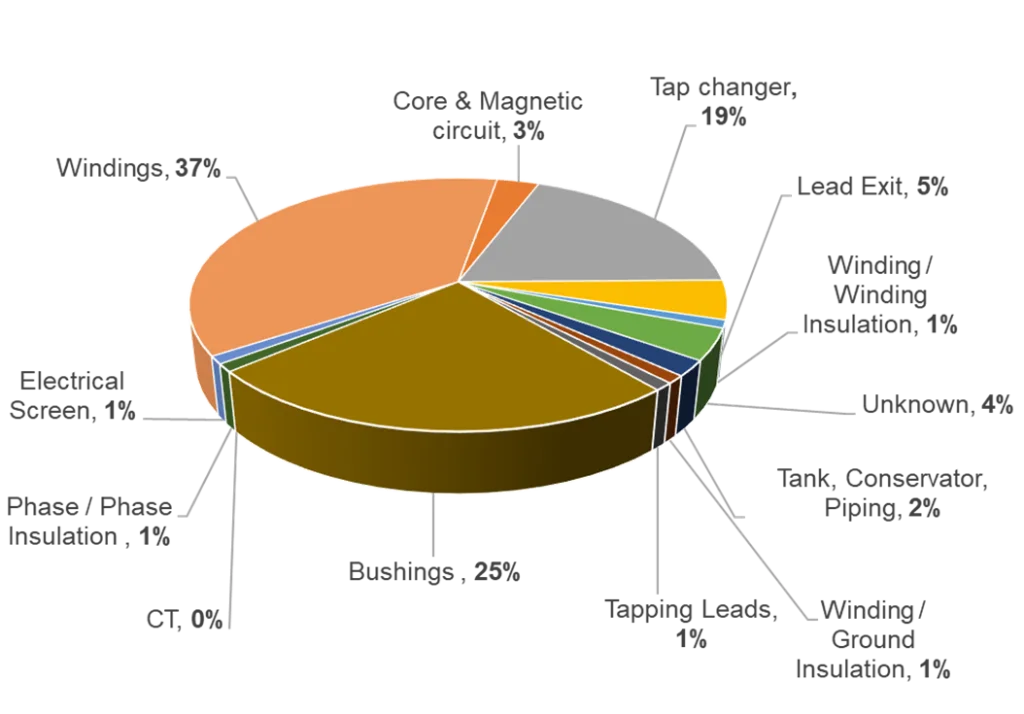
CIGRÉ Technical Brochure 939 identifies the transformer components with the highest failure risk: windings, bushings, and tap changers, as shown in Figure 2.
Capacitance Changes
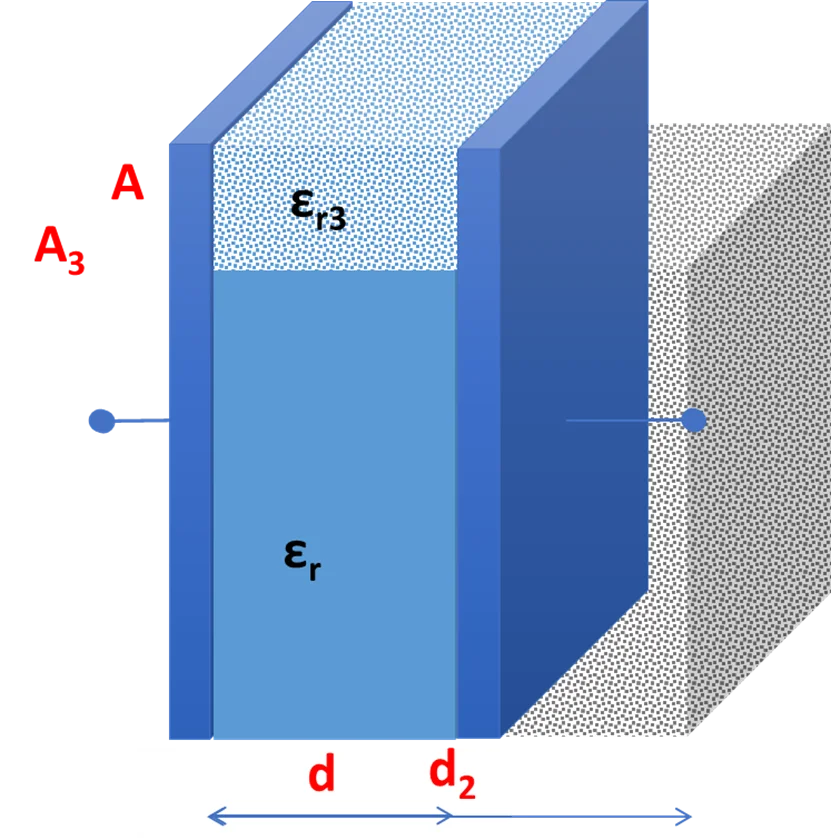
Changes in the dielectric material or the geometry of a capacitor directly influence capacitance. Capacitance is fundamentally related to the geometrical capacitance (Co), which depends on electrode area and spacing:
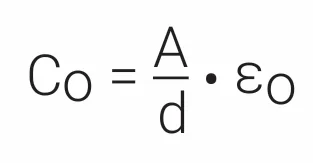
Where:
A – is the area of the electrode
d – is the distance between electrodes (spacing)
εo – is permittivity of free space
Capacitance also depends on the dielectric material between the electrodes, defined by its relative permittivity (εr). Therefore, capacitance is calculated as:
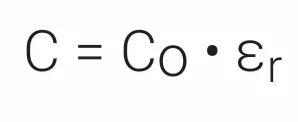
Thus, any deviation in geometry, dielectric properties, or material condition will produce measurable changes in capacitance—an important indicator of insulation health. Understanding capacitance behavior is therefore essential to effective diagnostics.
Limitations of Traditional Line-Frequency Power Factor
At 50/60 Hz, PF and DF provide only averaged information about the entire insulation system. This conventional approach presents several limitations:
- Strong temperature dependence
No universal correction curve fits all transformers, per IEEE C57.12.90. - Voltage dependence effects
Partial discharge or contamination can distort results when test voltage changes. - Masking of early degradation
Localized issues are often invisible in single-frequency testing. - Need for historical trending
Single values obtained at 50 or 60 Hz may not fully diagnose insulation health. Single values typically require diagnostic depth unless trustworthy long term trends are available.
These limitations have motivated the shift toward broader frequency analysis using DFR.
Narrow-Band DFR (NB DFR): The Modern Advanced PF Method
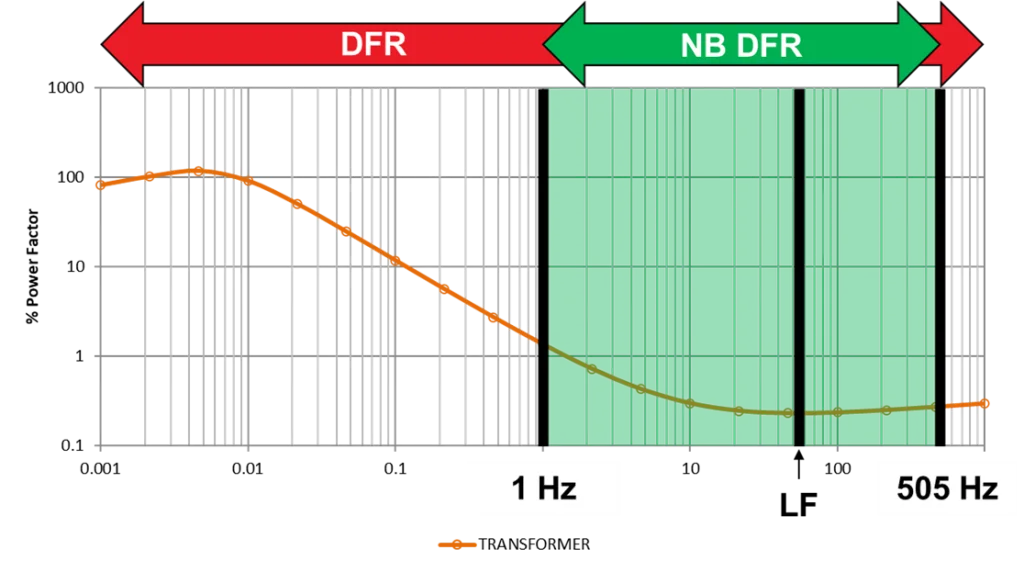
NB DFR (1 Hz–505 Hz) bridges traditional PF and full-scope DFR.
It provides:
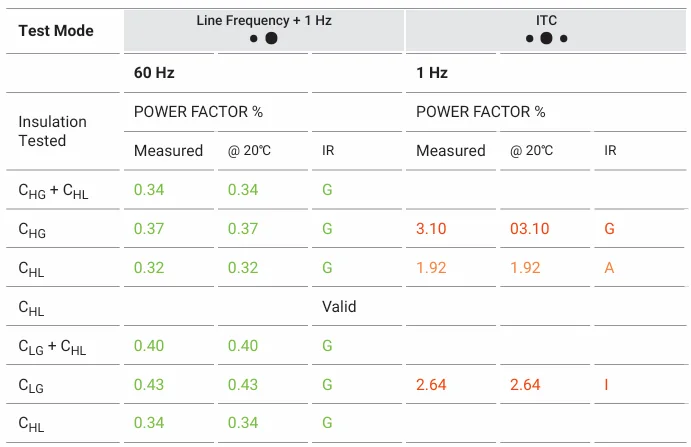
- Accurate, transformer-specific “Individual Temperature Correction” (ITC)
- Improved sensitivity to early contamination and insulation defects
- Elimination of historical trending requirement
- Enhanced visibility of issues that traditional 60 Hz PF may overlook
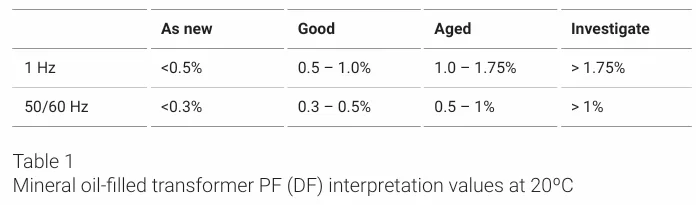
The 1 Hz measurement, taken alongside the 50/60 Hz PF, is particularly valuable for identifying emerging insulation issues. Table 1 presents interpretation values aligned with CIGRÉ TB 962 and the author’s research.
For complete interpretation, NB-DFR allows to extract the needed information to apply the Arrhenius equation and determine the “correct” correlation between the PF as a function of frequency and temperature. This is better explained in the next section dedicated to ITC.
Individual Temperature Correction (ITC)
Traditional temperature tables are inaccurate because they generalize the thermal behavior of insulation. ITC uses the Arrhenius equation and the unique dielectric signature of the capacitor under test to calculate a precise temperature shift for each transformer.
The Arrhenius equation can be used to model temperature-dependent property and perform temperature correction of the DFR results.

Where:
Ea is the activation energy corresponding to the insulation material
KB is the Boltzmann constant
Correction from temperature T1 to temperature T2 could be achieved by shifting the frequency (f) in logarithm scale by a factor L
ITC improves:
- PF/DF normalization to 20 °C
- Reliability of trending
- Cross-comparison between units
Note: The complexity of the insulation system determines how ITC must be applied. Oil filled transformers and oil filled bushings require different approaches.
Dielectric Response in Frequency Domain (DFR)
DFR measures PF/DF over frequencies typically ranging from 1 mHz to 1 kHz. Each frequency excites different physical processes within the dielectric materials:
- High & low frequencies → dominated by solid insulation properties and condition
- Mid frequencies → dominated by liquid insulation properties and condition
By analyzing the full dielectric spectrum, DFR can:
- Determine moisture content in cellulose
- Assess oil conductivity
- Distinguish oil vs paper influence
- Provide accurate temperature correction
- Reveal abnormalities invisible at 60 Hz
This makes DFR one of the most sensitive and conclusive tests for transformer insulation.
As power grids age, expand rapidly, and face supply constraints for power and distribution transformers, utilites increasingly encounter challenges finding the time and resources to properly interpret test data.
DFR for High Voltage Bushings
According to CIGRE TB 939 (Figure 3), bushings are responsible for up to 25% of transformer failures, often with catastrophic consequences.
Routine diagnostics typically include:
- C1/C2 capacitance
- 50/60 Hz PF/DF
- Oil sampling & DGA
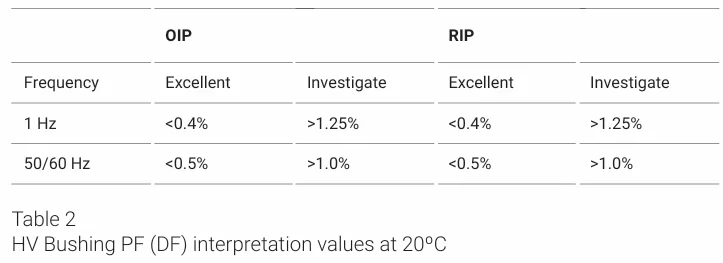
Industry limits at 1 Hz, and 50/60 Hz have been provided not only for mineral oil-filled transformers but also for different types of HV bushings, as presented in Table 2.
However, a full spectrum DFR obtained from 1 kHz down to 10 mHz, enables far earlier detection of:
- Moisture ingress
- Thermal degradation
- Contamination
- Layer by layer insulation defects
- Abnormal geometry shifts
Accurate diagnostics must evaluate both the solid and liquid insulation, detect changes in dielectric characteristics, and support predective maintennace strategies.
Case Studies
For better understanding and to evaluate the benefit of wider frequency spectrums to define the condition of the insulation system, several case studies are presented hereinafter.
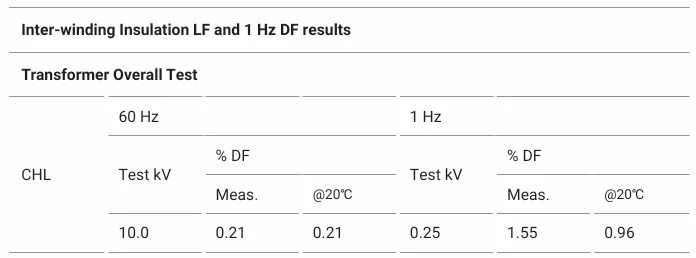
- New 16 MVA, 138 kV Transformer
- 60 Hz PF values appeared excellent.
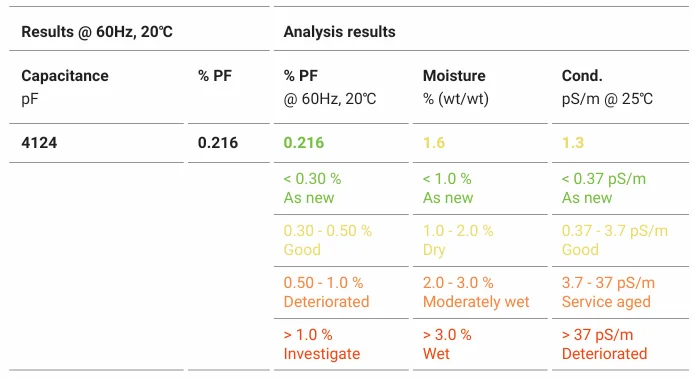
- However, considering this to be a NEW transformer, the 1 Hz limits were very close to the boundary between “good” and “aged”. This triggers the curiosity of the testing specialist on site and makes the decision to run a full spectrum DFR test, obtaining a result of 1.6% moisture in paper, indicating the transformer was not dry enough for energization.
- Dry out was recommended before service, preventing early life reduction and/or accelerated aging.
- 48 Year Old Mobile Substation Transformer
- PF values obtained at 60 Hz show good condition of the insulation system.
- 1 Hz shows the contrary. Values exceed acceptance limits and reflect a degraded insulation system, suggesting to perform a full spectrum DFR to better understand the issue faced.
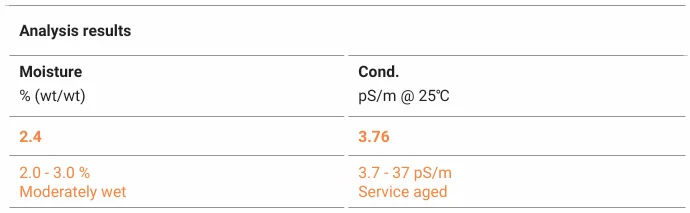
- DFR revealed elevated moisture and oil conductivity.
- The data indicated advanced aging, justified further intervention, and confirmed expected loss-of-life.
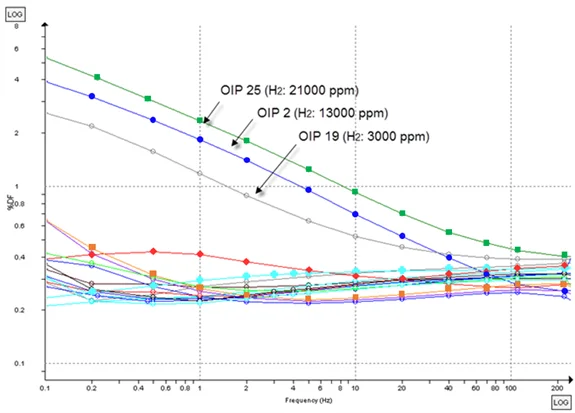
- 25 EHV OIP Bushings (735 kV)
- Several 735 kV reactor bushings failed in service.
- DFR measurements and oil analysis were performed.
- Most bushings were in good condition; however, three units were found to be severely deteriorated.
- Testing prevented catastrophic bushing failures like those that occurred previously.
Applications Beyond Transformers and HV Bushings
DFR technology is now applied in:
- Instrument Transformers, especially HV oil-filled Current Transformers
- Manufacturing (dry out monitoring, resin curing)
- Field dry-out of power and distribution transformers
- Repair shops (post drying validation)
Concluisons
Advanced dielectric diagnostics—especially DFR and 1 Hz assessments—represent a significant evolution in transformer condition monitoring.
Utilities benefit from:
- Early detection of insulation problems
- More accurate temperature correction
- Higher confidence in PF results
- Better asset health decisions
- Reduced risk of catastrophic failures
As transformer fleets age and operating conditions become more demanding, frequency based diagnostics are no longer optional—they are essential.
Any deviation in geometry, dielectric properties, or material condition will produce measurable changes in capacitance—an important indicator of insulation health.

Dr. Diego Robalino is the Global Industry Director for the Transformer Testing Business Unit at Megger, leading strategic initiatives in advanced transformer testing technologies and diagnostic solutions that enhance reliability and innovation in power systems. A Senior Member of IEEE and active member of CIGRE USA, Dr. Robalino serves on the IEEE/PES Transformers Committee, where he chairs the Dielectric Test Subcommittee. He has held key leadership roles, including General Chairman for the IEEE/DEIS Electrical Insulation Conference in 2020 and 2022. His contributions have earned him the IEEE Transformer Committee Outstanding Service Award and the CIGRE General Session 2024 SC A2 Best Paper Award. Dr. Robalino holds a Ph.D. in Electrical Engineering from Tennessee Technological University, with research focused on power system optimization and aging equipment assessment. He has authored over 50 technical publications on transformer testing, monitoring, and diagnostics, and remains committed to advancing technical standards and fostering global collaboration in the power engineering community.

This article was originally published in the May 2026 issue of the Reliability Engineered Design magazine.
View Magazine